

Why the Brightest Shadow Can Never Outshine the Darkest Light
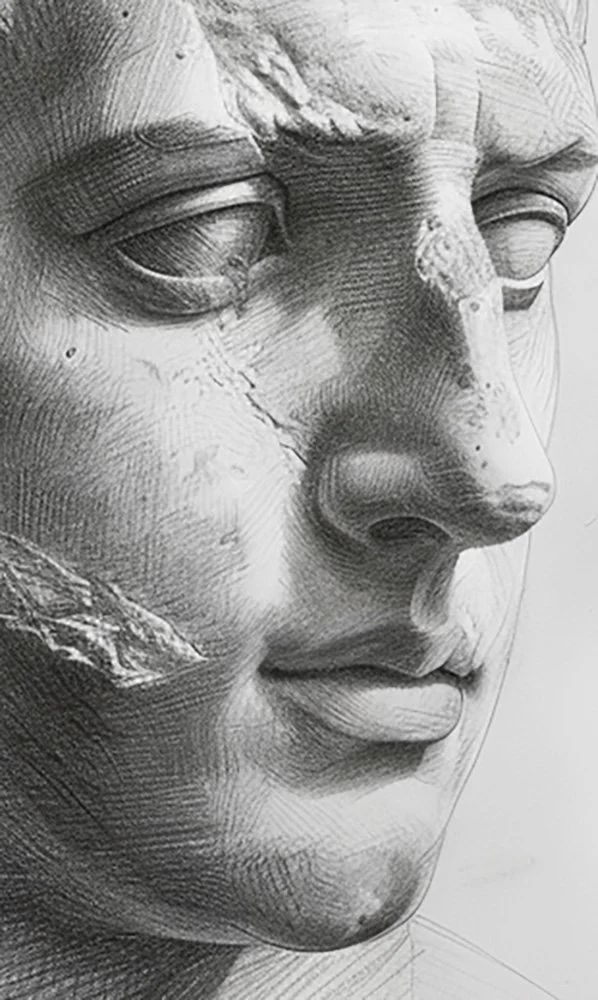
Darkness here is not painted, but constructed—line by line.
The boundary between light and darkness
is far clearer than we often assume.
The more precisely this rule is understood and expressed,
the stronger a drawing becomes,
and the more solid its sense of form.
Of course, depending on the shape,
this rule may appear weakened or obscured.
But even then,
it is only through variations that respect the underlying principle
that a form gains true completeness.
When I was young and learning to draw,
this realization allowed me
to approach plaster casts with greater stability and confidence.
Even now,
as I work with virtual reality and three-dimensional effects,
this principle remains my point of reference.
I want to return once more
to my thoughts about light and darkness—
about how closely they are bound to each other.
Everything in the world becomes visible to us through light.
Yet no object can exist with only a bright side,
just as nothing can exist in complete darkness alone.
Pure black paint may exist as a material,
but as a principle of form,
a bright surface can only exist
when it is accompanied by darkness.
This is how objects come into being.
The light we are most familiar with
falls from above.
Upper surfaces receive light,
while lower surfaces naturally fall into shadow.
When this direction is reversed,
we feel an immediate sense of discomfort.
This is why horror films so often place light below the face—
the familiar order collapses,
and something feels fundamentally wrong.
I refer to these shadowed areas
as “supporting surfaces.”
A supporting surface is dark,
but it is never completely dark.
Within it, lighter areas still exist,
and a distinct internal logic of light and shadow continues to operate—
one that carries its own sense of volume and depth.
Still, there is one rule that never breaks.
“The darkest point within a bright area
is always brighter
than the brightest point within a dark area.”
And conversely,
“The brightest point within a dark area
is always darker
than the darkest point within a bright area.”
Over time,
I formally studied art,
continued into advanced design research,
and eventually began operating a company
focused on developing VR content grounded in form and spatial sensibility.
I have taught design and 3D expression at the university level for many years,
and I have worked across fields ranging from sports and golf
to science, medicine, military training, construction,
and technical education through virtual reality.
Looking back,
all of these paths trace back
to a simple understanding I formed early on—
an understanding of light and darkness
learned through drawing.
And as time passes,
one truth becomes increasingly clear.
This dynamic relationship between light and dark
does not exist only on paper.
Life itself operates in much the same way.