

The Philosophy of a Line: Why a Single Stroke Dictates Light and Shadow
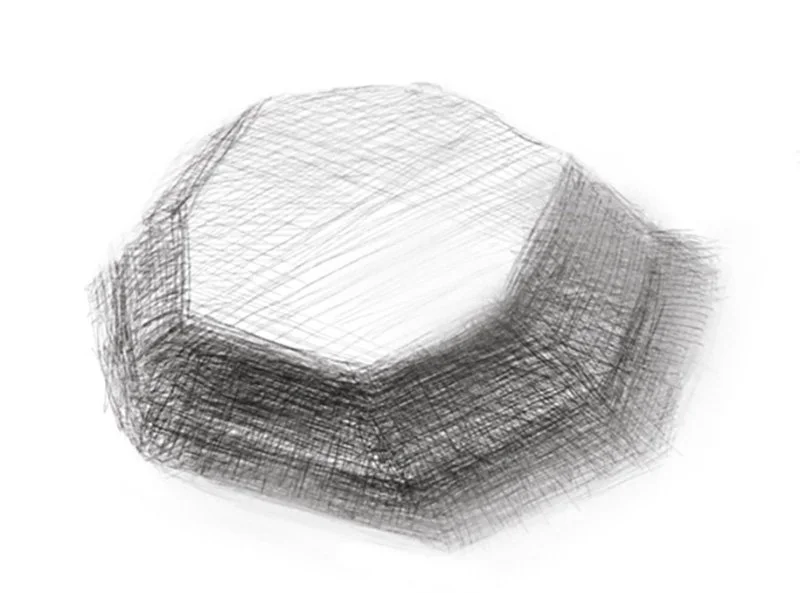
This drawing records how planes emerge through the density and direction of lines, rather than through outlines.
It all begins with an idea. Maybe you want to launch a business.
Light can be imagined as a mass,
or as countless particles gathered together.
Yet because light travels in a direction,
it is often described as a line.
In drawing, a single line represents the passage of light.
When these lines overlap, they form planes.
Through those planes, moments of brightness and darkness are decided,
and eventually, an image comes into being.
When learning to draw, one often hears the advice:
“Draw lines that cling to the plane.”
Such lines do not physically exist,
and yet, conceptually, they do.
A line describes a plane,
but at the same time, it describes space.
It traces the path that light might leave
as it passes through that space.
These lines are never isolated.
They are always connected.
When an object exists as a single mass,
no matter how complex its depth or grooves may appear,
that mass remains unified
through continuous lines and planes.
For the form to be perceived as complete,
there must be a supporting plane beneath it—
a surface that allows the mass to exist as one.
The word “mass” may sound imprecise,
but I have yet to find a better word
to describe the result created
by light and shadow.
When the elements that form a plane are separated,
the mass is no longer perceived as one.
It becomes fragmented—
two, three, or more parts.
I begin by defining the form
with large lines and large planes.
Only then do I subdivide the interior,
breaking the structure down
into smaller planes.
The straight lines used to define these planes
overlap densely to create shading.
In this process,
the angle of each line is not the most important factor.
What matters is the direction of the light.
If light comes from a single direction,
every plane naturally aligns itself
in relation to that direction.
If the light is scattered
and arrives from multiple directions,
the angles of the lines may vary freely,
allowing contradictory directions to coexist.
In this way,
a single line—used to describe light—
becomes a tool for constructing planes,
capturing the overall flow of form
and gradually refining its details.
I have applied this understanding of line and plane
when creating 3D objects
and when shaping large terrains,
always considering the direction of sunlight
to achieve a sense of realism.
Through this approach,
I have been able to guide projects to success
across different fields.
The audience may not know
why something feels convincing.
But the maker knows.
When a work is created
with a clear understanding
of the relationship between light and shadow,
it carries a sense of coherence
that naturally resonates with others.
Through LUMISCA,
I aim to explain this relationship—
slowly and carefully—
using paper as the medium.