

Why Simplicity in Paper Craft Is Actually Necessary Omission
(Creativity in the AI Era)
(Structural Thinking and Creativity in the AI Era)
In the AI era, many people are asking the same question.
What will define human creativity in the future?
Images can be generated by AI.
Texts can be written automatically.
Even design concepts can be produced within seconds.
Because of this shift, creativity is no longer defined by how much we can produce,
but increasingly by what we choose to keep and what we decide to remove.
This is not only a design problem.
It is a matter of structural thinking.
Interestingly, the same principle appears clearly in paper craft.
Paper Craft Is Not Decoration — It Is Structural Design
Paper is a very simple material.
It is thin.
It is light.
It bends easily.
But once planes, angles, and edges are introduced,
paper suddenly begins to behave like a structure.
Paper itself may be fragile,
but structure is not fragile.
In paper craft design, the key question is not how many details can be added.
The real question is:
Where should the form stop?
This becomes especially clear when designing curved surfaces.
A curve can theoretically be divided into an infinite number of planes.
The more planes you add, the smoother the curve appears.
But beyond a certain point, something unexpected happens.
When too many planes are added:
the structure becomes weaker
the flow of light becomes unclear
the visual clarity of the form disappears
At that moment, omission becomes necessary.
Necessary Omission
One of the most important principles in paper craft design is this:
Simplicity is not the goal.
Simplicity is the result of calculated omission.
Which planes should remain?
Which edges should define the structure?
Which surfaces should disappear?
These decisions are not purely aesthetic preferences.
They are structural judgments.
The omitted planes are not empty space.
Instead, they create:
pathways for light
boundaries where shadows form
rhythm within the overall form
In this way, the planes in paper craft are not decoration.
They become a tool for shaping light and shadow.
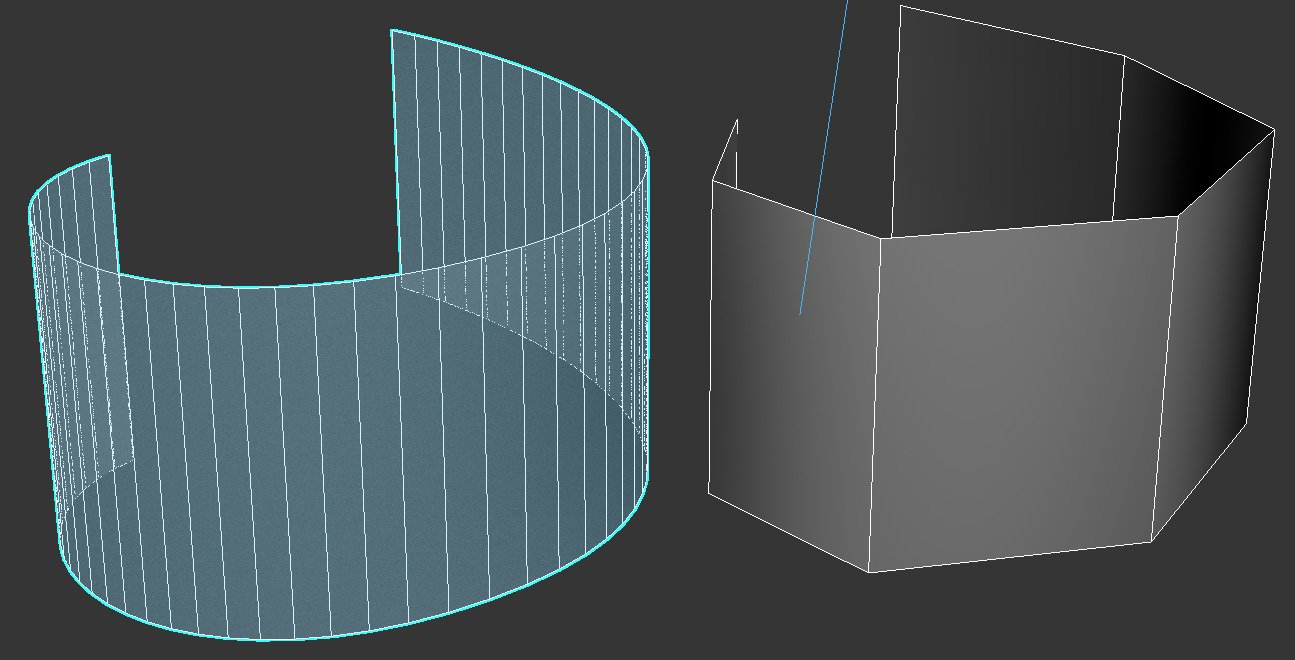
This diagram shows how a curved surface in paper craft is translated into structural planes. Instead of preserving a continuous curve, the form is simplified into flat surfaces that stabilize the structure and control how light and shadow appear.
Light Reveals, Shadow Supports
The core philosophy behind the LUMISCA project can be expressed in one sentence.
Light reveals.
Shadow supports.
Light allows the form to appear.
But the structure that holds the form together
is often hidden in shadow.
When planes meet,
when edges lock into position,
when light is interrupted,
the structure becomes stable.
The material remains paper.
But the form becomes sculpture.
Simplicity Is Not a Style — It Is a Structure
When people see LUMISCA works, they sometimes say:
“It's beautiful because it is simple.”
But in reality, simplicity was never the objective.
The form appears simple
because many surfaces were intentionally omitted.
Planes support one another.
Edges connect structures together.
Light reveals the geometry.
At that moment, the structure stabilizes.
Completion is not the final result.
Completion is the moment when structure becomes fixed.
Creativity in the AI Era Begins with Removal
In today's creative environment, production has become easier than ever.
Images can be generated instantly.
Texts can be produced automatically.
Designs can be created within seconds.
Because of this, the meaning of creative work is changing.
In the past, creativity often meant:
producing more.
Now creativity increasingly means:
deciding what to remove.
This is becoming one of the most important abilities in creative work in the AI era.
Paper craft reveals this principle in a very clear way.
Form does not appear by endlessly adding elements.
Form appears when unnecessary planes are removed.
That is why structures that look simple
often contain the most careful thinking.
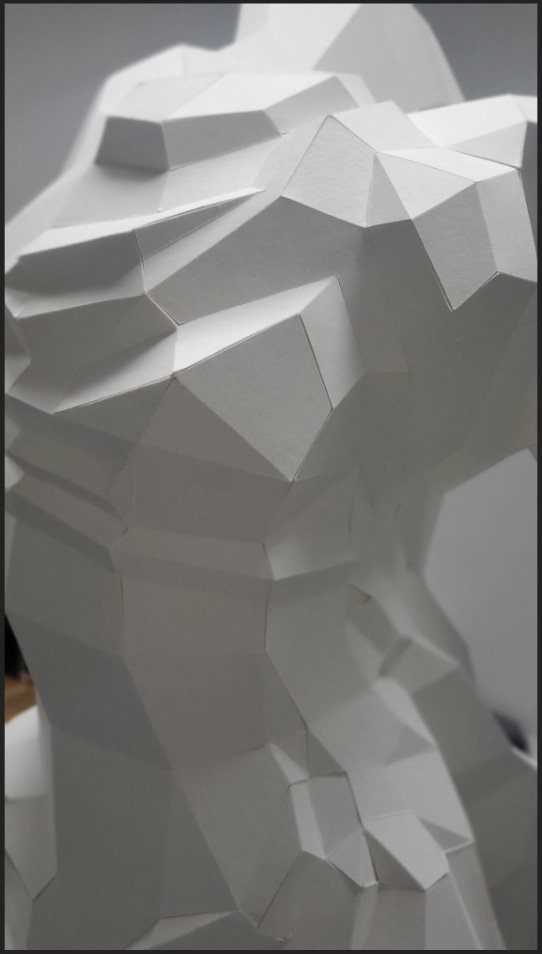
The torso of the Winged Victory of Samothrace reconstructed with planar paper surfaces. Instead of smooth curves, the form emerges through carefully omitted planes, where light and shadow reveal the structure of the body.