

Paper. Why?
Why I Choose Paper — A Personal Story of Strength, Light, and Shadow
Paper is not a weak material. At least, it has never been weak to me.
Thin, lightweight, and easily damaged by water, paper is often considered fragile.
But the paper I have known is a little different.
Of all the materials in the world, why paper?
The answer begins a long time ago.
Paper Is Stronger Than It Looks
For me, paper has never been just a material for making things.
During a difficult childhood, it became one of the few ways I could connect with the world.
There were times when life felt almost impossible to endure.
I don't intend to tell every story from those years here. But one thing is certain: the hours I spent working with paper helped me keep going.
Paper never gave me any answers.
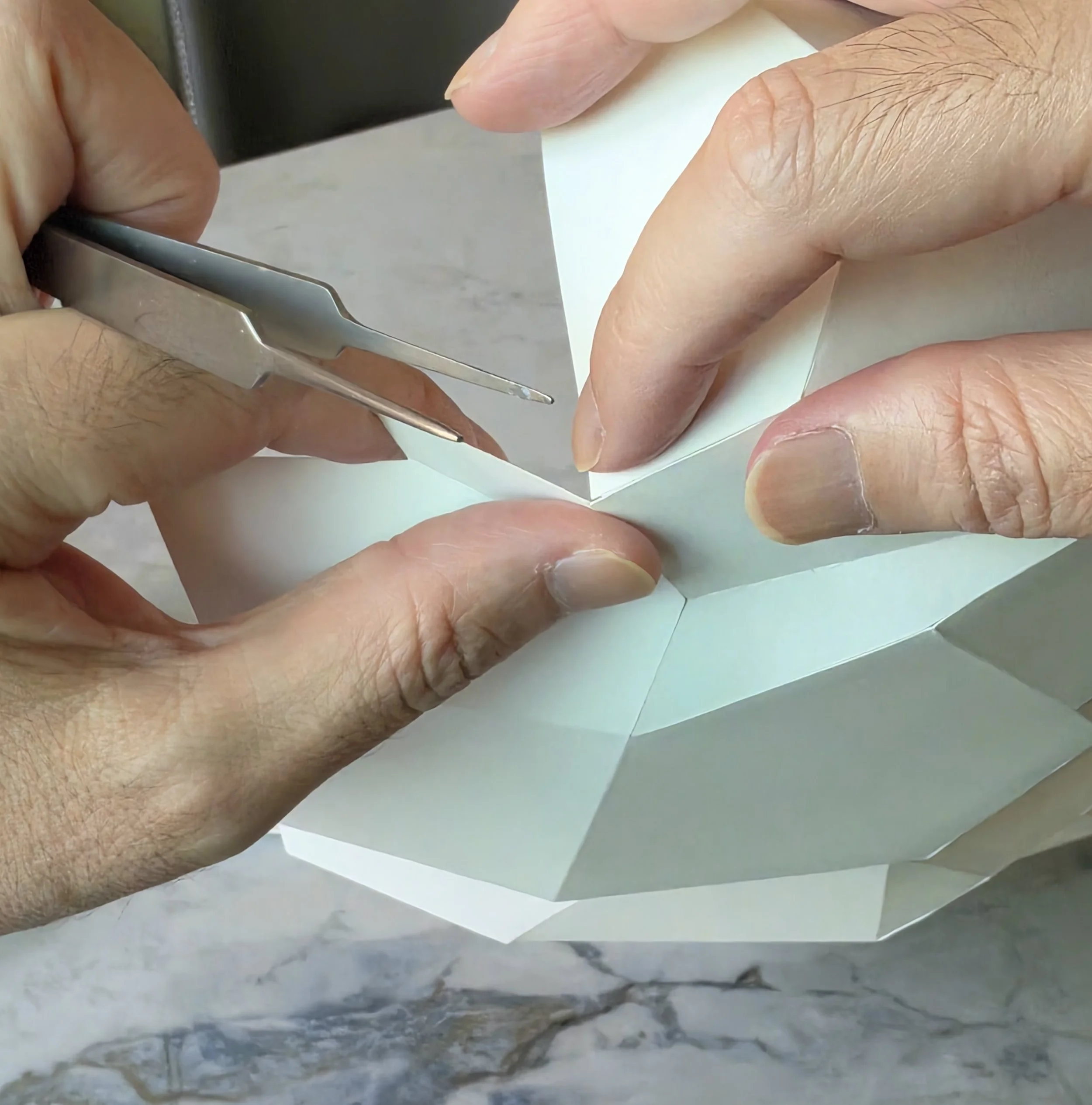
It simply allowed me to unfold a sheet, cut it, fold it, connect its edges, and create a small world of my own.
There was always something fascinating about watching a flat surface become a three-dimensional form.
Perhaps those little moments helped shape the person I am today.
The Warmth of Paper
Touch a sheet of paper, and you may notice something different.
It doesn't feel cold like metal or perfectly smooth and uniform like plastic.
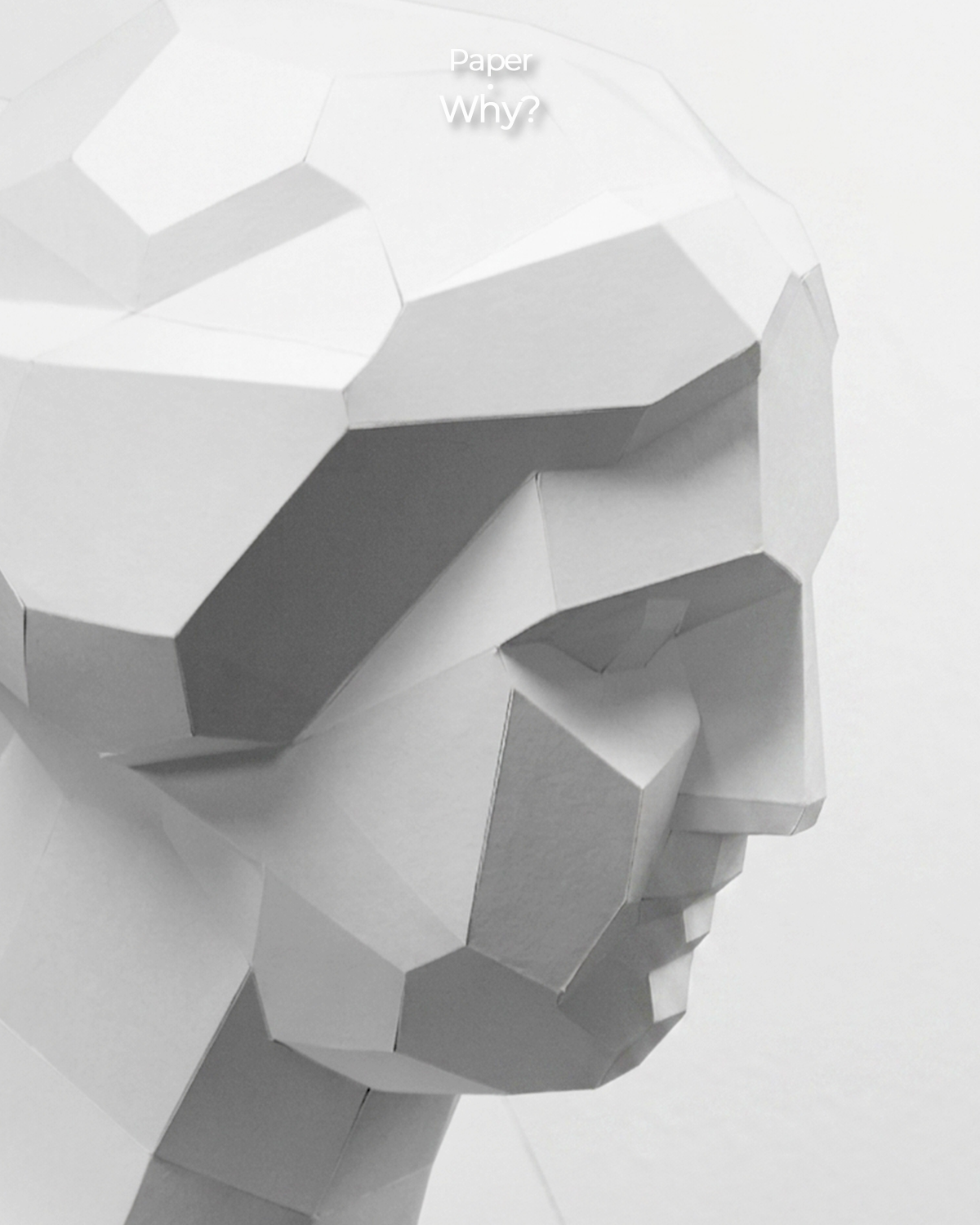
Paper has a subtle texture formed by its fibers. Under light, that texture becomes gently visible. In your hands, it has a softness all its own.
It doesn't need elaborate decoration or brilliant colors to become beautiful.
A single sheet of white paper can be enough to create a remarkable form.
That is why LUMISCA paper sculptures preserve as much of the paper's natural texture and color as possible.
I don't want to cover up the warmth that is already there.
Sculpting Light and Shadow with Paper
While preparing for art school, I came to understand something through drawing.
The brightest plane meets the darkest plane.
Light and darkness may seem like opposites, yet they coexist within a single form.
Over the next 30 years, I worked in IT and 3D technology, creating countless three-dimensional forms and developing expertise in simplifying and optimizing complex geometry.
Through that experience, I became deeply familiar with Low Poly modeling — reducing unnecessary details while preserving the essential planes that define a form.
What fascinated me was how clearly these simplified structures revealed something I had understood years earlier through drawing.
On complex curved surfaces, light and shadow transition gradually. But in simple Low Poly geometry, the angles between planes make their differences much more visible.
Low Poly is a way of revealing, with remarkable simplicity, how light and darkness coexist within a single form.
And paper became the material through which I could bring that structure into the physical world.
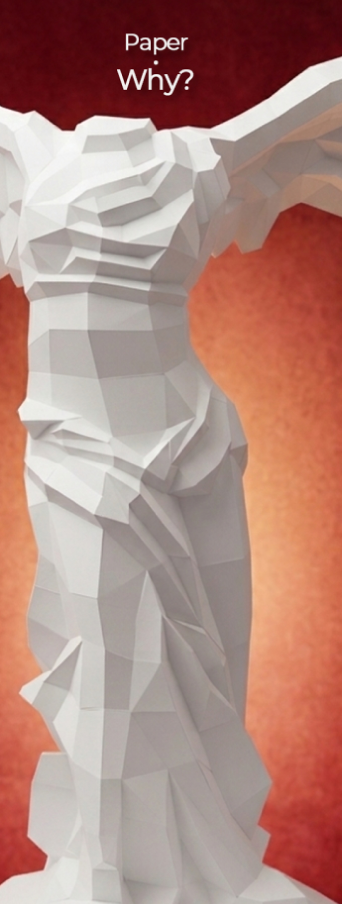
By folding and connecting sheets of paper, the simplified planes of digital geometry become real, three-dimensional sculptures.
No elaborate colors or special surface effects are needed. The angles of the planes and the direction of light are enough to reveal brightness and darkness.
Morning and afternoon. Summer and winter.
The sculpture remains still, yet changing light reveals new surfaces and creates different shadows.
The same paper sculpture offers a slightly different view every day.
I love watching that happen.
Why I Still Choose Paper
AI can generate images in seconds, calculate complex forms, and produce remarkable results at extraordinary speed.
Having spent much of my life working with digital technology, I understand its possibilities.
Yet lately, I have come to appreciate the quiet time spent working with a single sheet of paper.
Paper doesn't fold itself simply because we are in a hurry.
One plane must be formed, another connected, and each angle carefully aligned before the sculpture takes shape.
The process carries the touch of our hands, the passage of time, and even our small mistakes.
I don't believe digital technology or handmade art is inherently more valuable than the other.
I simply believe that even in a rapidly changing world, the experience of making something with our own hands still matters.
All these experiences and ideas eventually came together to become LUMISCA.
But the reason I continue working with paper is much simpler.
Paper still brings me joy.
The moment a flat sheet is folded and connected into a new form.
And the moment light touches that form for the very first time.
I still love watching it happen.
Paper. Why?
Perhaps the answer lies in those moments — and in why I have never been able to put paper aside.
LUMISCA — Sculpting the Light